Every year, usually around January, someone will tell you with complete confidence which asset class is about to have a great run. Gold this time. No, small companies. No, this is the year property finally wakes up.
Some of them turn out to be right. None of them knew.
Imagine for a moment that you genuinely did know — that you had a working crystal ball. You would not need a portfolio at all. You would put everything into the one thing that was about to rise, sell it near the top, and move to the next one. The entire business of spreading money across different assets exists only because that machine does not exist.
What asset allocation actually means
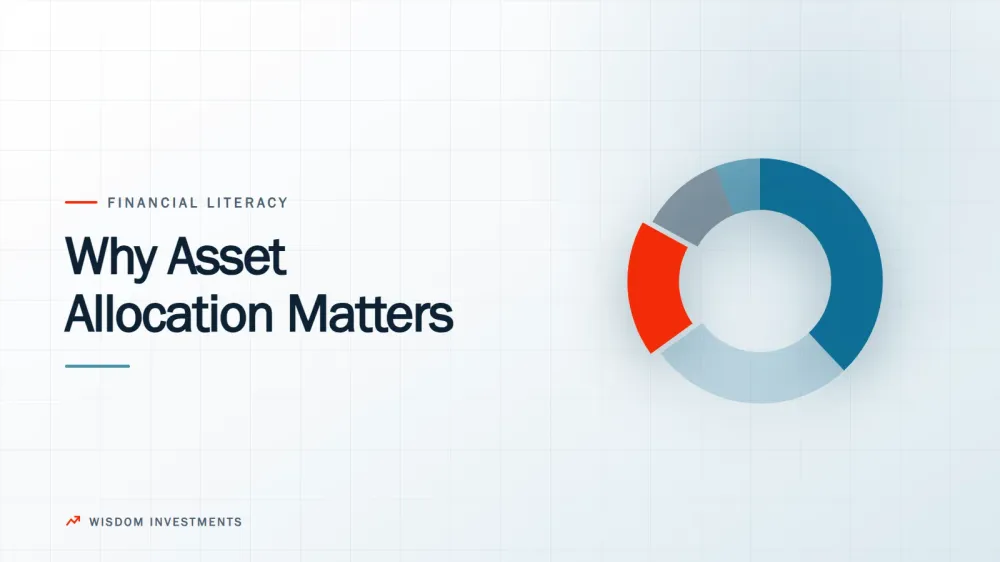
Asset allocation is the decision about how your money is split across broad categories that behave differently from each other: equity, fixed income (bank deposits, provident fund, bonds), gold, property, and plain cash. Not which fund. Not which stock. Just the shape of the pile.
It sounds like the boring part. It is usually the part that decides most of what happens to you.
The reason is arithmetic, not theory. If seventy per cent of your money sits in one asset class, then seventy per cent of your portfolio moves when that class moves. The particular holdings inside it shift the result at the edges; the class itself sets the ride. Get the mix wrong and a well-chosen stock sitting in a small corner of the portfolio will not rescue the rest.
The shop that sells umbrellas and sunglasses
You have probably walked past a shop selling both umbrellas and sunglasses and thought it an odd pairing. Who buys both on the same day? Almost nobody — and that is exactly the point.
When it rains, umbrellas move and sunglasses sit. When the sun is out, the reverse. The shopkeeper is not trying to win on both counts at once. He is making sure there is no day on which he sells nothing.
A portfolio works the same way. You are not assembling things that all rise together. You are assembling things that do not all fall together.
Owning five things is not the same as owning different things
Here is where people usually go wrong. Suppose that instead of one large technology company you buy three. You now hold three stocks. Have you diversified?
Barely. They sell into overlapping markets, they are priced off the same collective mood about the sector, and when that mood turns they fall together. You have spread your money without spreading your risk. Five equity mutual funds with similar mandates have the same problem: five lines on your statement, one bet underneath them.
Real separation comes from assets driven by different forces — where one is doing badly precisely because another is doing well. That is the property you are actually paying for, and it is uncomfortable to hold, because it guarantees that some part of your portfolio always looks like a mistake.
So what should the mix be?
There is no single answer, and anyone who offers you one without knowing anything about you is not really answering the question. The mix follows from things only you can see:
- When you need the money. Money for next year and money for twenty years from now do not belong in the same place.
- How stable your income is. A salaried person with a secure job and a business owner with lumpy cash flows are already carrying very different risks before they invest a single rupee.
- What you already own. A home bought with a large loan is a big, borrowed, hard-to-sell position in one asset in one city. It counts, even though it does not appear on any statement.
- How you actually behave in a fall. Not how you say you will behave. A mix you can hold through a bad year is worth more than a mix that looks better on paper and gets abandoned in March.
Equity is the asset people hold because they expect to be compensated for tolerating its swings. That compensation is not scheduled, not promised, and the swings arrive first. A mixed portfolio tends to produce a less impressive best year and a far more survivable worst one, and the second of those is what keeps people invested long enough for anything else to matter.
It is not a one-time decision
Markets move, so your mix drifts on its own. A strong run in one asset leaves you holding more of it than you ever chose to hold — and it has usually become more expensive along the way. Left alone for long enough, a portfolio quietly turns into a concentrated bet on whatever last did well.
Comparing what you hold against what you intended to hold, at some fixed interval you decide in advance, is what keeps the decision yours rather than the market's.
You cannot forecast which asset class wins next year. You can decide, in advance and while you are calm, how much of your money any single one of them is allowed to speak for.
This article is general information for education only. It is not investment advice and does not take account of your circumstances. Investments in securities are subject to market risks; please read all related documents carefully before investing.