You opened a demat account two years ago. You read a few things, decided you needed to understand it better first, and put it aside. Every few months you think about it again, and every few months something makes waiting feel sensible — the market looks expensive, or a big expense is coming, or you just want a clearer head about it.
That is not laziness. It is the most ordinary thing in the world. But it has a price, and the price is not obvious, because nothing visibly goes wrong while you wait.
What delay actually costs
The instinct is to think the cost of waiting two years is the money you did not put in during those two years. It is not. That money is still in your bank account. You can still put it in tomorrow.
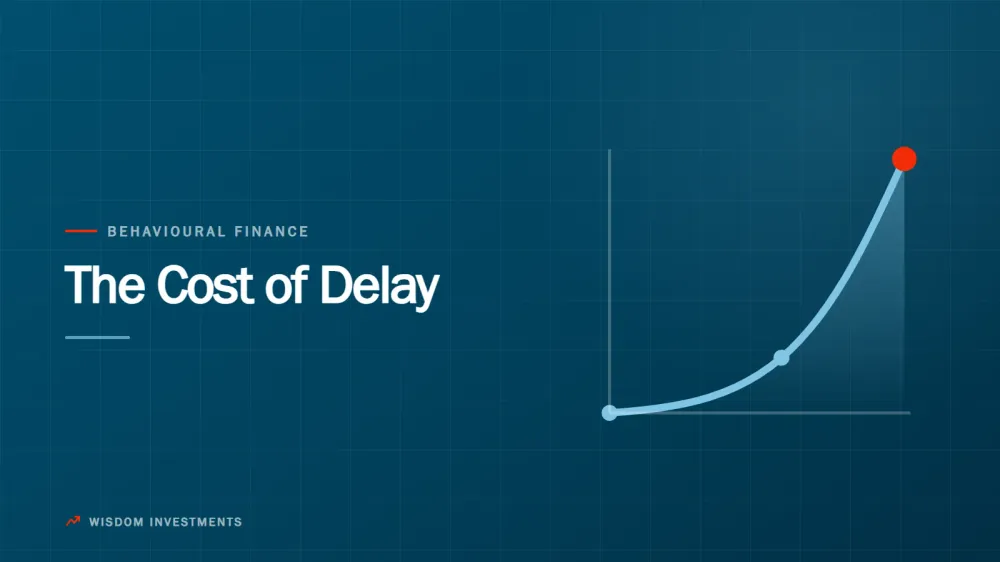
What you cannot get back is the two years themselves. Money that is invested is doing something over time, and the time is the part that cannot be bought later. You can raise the amount you put in whenever your income allows. You cannot go back and give an amount more years than it has.
That is why a delay is quiet and expensive at the same time. Nothing bad happens on the day you postpone. The cost shows up much later, as a gap between where you are and where you would have been, and by then it is not fixable by trying harder.
Waiting for certainty is waiting for something that does not arrive
There is no such thing as perfect timing. Whether a decision was the right call is something only hindsight tells you, and hindsight is not available in advance. So if your condition for starting is "when I am sure", you have set a condition that will never be met.
Notice too that indecision is not neutral. Choosing not to act is a choice, with its own consequences. It only feels safer because it does not require you to sign anything.
The question you are probably avoiding
Often the real block is not when to start but what to do with the money, and that question is more answerable than it feels.
The thing that does most of the work in that decision is your time horizon — how long it will be before you actually need this money. Money you might need in a year or two cannot sit somewhere whose value moves around a lot, because you may be forced to take it out on a bad day. Money you will not touch for fifteen years can sit through those bad days, because you are not being forced to sell into them.
Different kinds of investments differ enormously in how much their value moves in the short run, and that variation is the thing to weigh against your own horizon. That is a matter for you to work through for your own situation, and for a qualified professional if you want one — but it is a narrower question than "what should I do about money", and narrower questions get answered.
What you can actually control
You cannot control what markets do, and you cannot control whether the next few years are kind. Three things are genuinely in your hands: when you start, how much you put in, and whether you leave it alone.
Only the first of those three has a deadline attached, and it moves further away every month you do not deal with it.
This article is general information for education only. It is not investment advice and does not take account of your circumstances. Investments in securities are subject to market risks; please read all related documents carefully before investing.