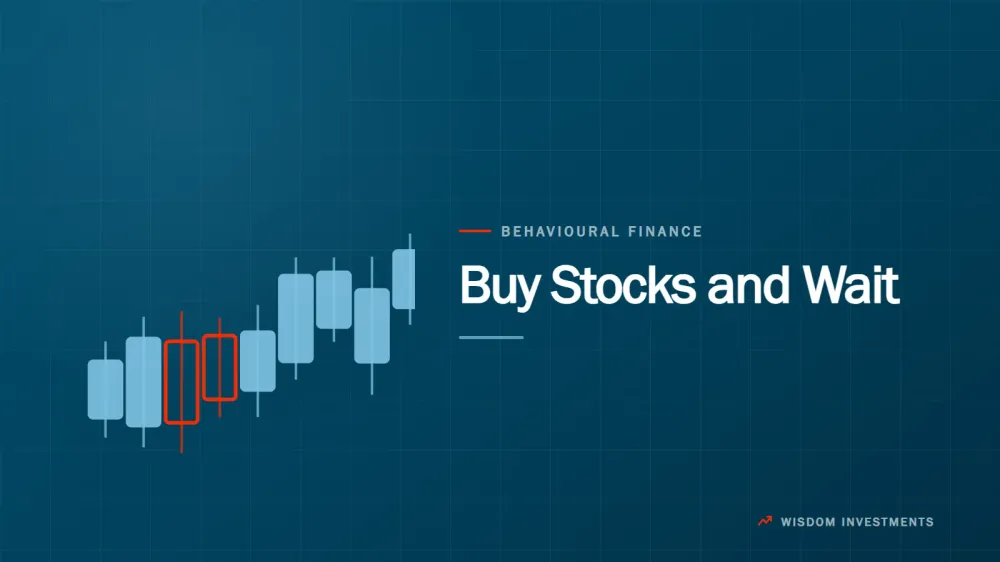
You have probably seen the line on a poster or at the end of somebody's presentation: don't wait to buy stocks, buy stocks and wait. It gets repeated so often that it has stopped meaning anything much.
It is worth slowing down on, because the saying is not really about buying at all. It is about which of the two halves of an investing life actually does the work — and most people have it the wrong way round.
Two different jobs
Every investment involves two things. There is the decision — what to own, at what price, in what quantity. And there is the duration — how long you leave it alone afterwards.
Almost all the attention and anxiety in this subject goes into the first. People read, compare, debate and postpone, all in service of getting the entry right. The second gets almost none, because it does not feel like doing anything.
The saying is a claim about the balance between the two: that over a long enough period, duration ends up mattering more than the precision of the entry. Not that the decision is unimportant — a bad decision held for thirty years is still a bad decision. But a reasonable decision left alone tends to beat a slightly better one that never got made.
Why time carries so much weight
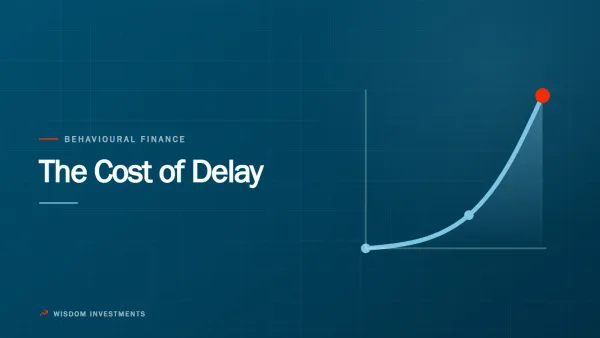
Growth compounds on a base that is itself growing, so each year adds more than the year before it in absolute terms. The growth in year twenty is applied to a much larger number than the growth in year two.
A rough way to see it: at any steady rate, money doubles about every seventy-two divided by that rate, in years. At an assumed 12% a year — an assumption for arithmetic only, not a rate anybody is offering you or should expect — that is a doubling roughly every six years.
Follow it through. Thirty years is about five doublings, and the last of those five adds more to the total than the first three put together, because it works on the largest base. The final stretch is where most of the value shows up.
So the years you give up by starting later are not the small early ones you imagine. They come off the far end, where each year counts most. That is the real content of the saying.
Real investments do not grow at a steady rate. They fall for long stretches, sometimes years. The illustration above shows a shape; it is not a forecast and not a promise of any return.
The tree, and the eleven-year-old
Warren Buffett put the same idea more plainly:
Someone's sitting in the shade today because someone planted a tree a long time ago.
He is a useful illustration of his own point. He bought his first shares at eleven, and has said more than once that he regrets not starting sooner. A man widely regarded as the finest investor of his era looks back and names time, not skill, as the thing he wishes he had more of.
What the saying does not say
It does not say buy today, and it is not a view on whether anything is cheap or dear. Nobody who repeats it, including me, knows what prices do next.
It also does not say any particular thing is worth owning. The phrase is useless if the waiting is done on something you never understood, or with money you will need back in eighteen months. Duration only helps if you can see it through, and you can only see it through if the money is genuinely spare and you know why you own what you own.
Read properly, the saying is a warning about one habit: postponing a decision indefinitely in the hope of making it slightly better, while the clock — the one thing you cannot get back later — runs down in the background.
The tree does not care whether you planted it in a good year. It cares how long ago you planted it.
This article is general information for education only. It is not investment advice and does not take account of your circumstances. Investments in securities are subject to market risks; please read all related documents carefully before investing.