Look at an old recurring deposit or provident fund statement, the kind that runs for several years on one page. The amount you put in each month is the same line, repeated. But the interest line is not the same. It is a little larger every year, even though you never changed anything.
Nobody increased your rate. What changed is the size of the thing the rate is being applied to. That is compounding, and understanding the mechanism is more useful than being impressed by it.
Interest on interest, and why that matters
Simple interest pays a return on what you originally put in. Compound interest pays a return on what you put in plus every return you have already earned and left alone.
Take a plain arithmetic illustration. The rate below is picked only to make the sum easy to follow — it is not a forecast, not an expected return, and not a rate you should assume any investment will deliver.
Suppose ₹1,00,000 grows by 10% in a year. At the end of the year you have ₹1,10,000. In the second year, the same 10% is applied to ₹1,10,000, not to ₹1,00,000 — so it adds ₹11,000 instead of ₹10,000, and you have ₹1,21,000.
That extra ₹1,000 is the whole idea. It is the return earned by last year's return. It is small the first time. Its importance is that it happens again, on a slightly bigger base, every single year, and each of those extra bits then earns as well.
Why it feels slow and then does not
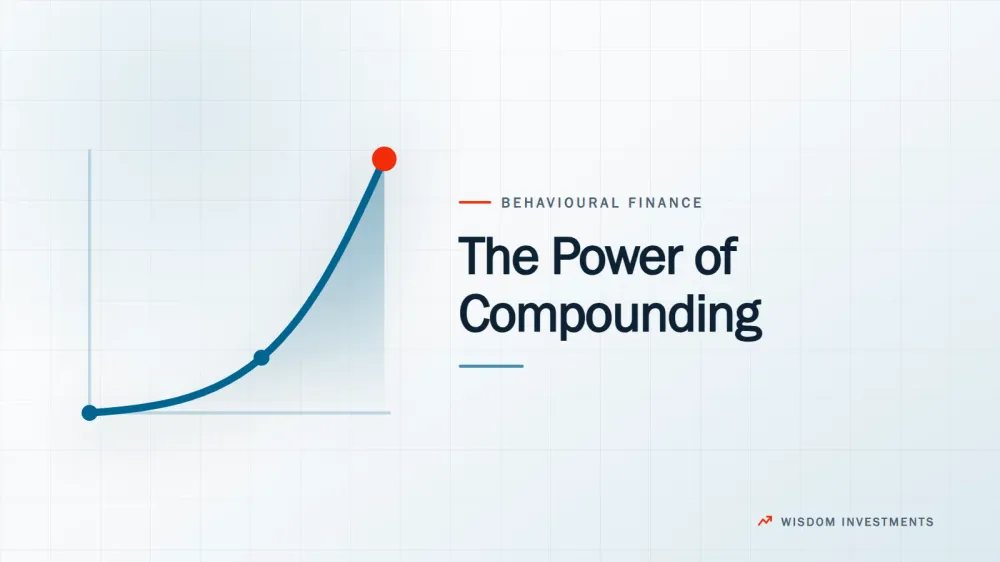
Growth of this kind is not a straight line. In the early years the base is small, so the amount added each year is small, and it can honestly look like the money is just sitting there. That is not a sign the thing is not working. It is what working looks like at that stage.
Later, the base is much larger, and the same percentage adds a much larger amount. The curve does not suddenly change its nature. It was always doing this. It only becomes visible once the numbers are big enough for you to notice.
What interrupts it
Compounding is arithmetic, not magic, and the arithmetic depends on one thing staying true: the base has to keep growing. Anything that takes a bite out of the base slows everything that follows.
- Withdrawing the returns. If you take out the gains each year and spend them, you have converted compound growth into simple growth. The base never grows, so next year's return is the same size as this year's.
- Stopping and restarting. A gap is not just the contributions you skipped. It is also every future return those contributions would have gone on to earn.
- Costs. Fees, charges and taxes taken along the way come out of the base. A small annual leak matters far more over a long period than it looks like it should, for exactly the same reason a small annual gain does.
The honest caveat
The illustration above assumes a steady rate every year, because that is the only way to show the mechanism clearly. Real market-linked returns do not arrive that way. Some years are strong, some are weak, and some are negative. Nothing here should be read as suggesting a fixed annual return exists to be relied on.
The mechanism still holds. It just means the two inputs compounding needs — returns that are actually earned, and time in which they are left alone — are less predictable than a textbook example makes them look. The one you have real control over is the second.
This article is general information for education only. It is not investment advice and does not take account of your circumstances. Investments in securities are subject to market risks; please read all related documents carefully before investing.