You skip a dinner because you have work, or a cousin's function, or you are simply tired. The next morning you find out it turned into drinks, then somebody's terrace, then apparently the best night anyone has had all year. You scroll through the photographs feeling slightly sick.
Nobody can be at everything. But that feeling — that something better is happening elsewhere, without you — is one of the more reliable features of being human, and social media has turned the volume on it all the way up.
It shows up in your money too, and there it costs more than a missed evening.
Two fears, not one
Investing produces two opposite fears, and most people only recognise the second one.
There is the fear of being in — the sick feeling when what you own is falling and you want out. In March 2020, when markets fell very fast and nobody knew how bad the situation would get, that fear was everywhere.
And there is the fear of missing out — the itch when things are rising and you are not in them. Over the year or so that followed March 2020, as prices recovered, the same people who had wanted out were kicking themselves for not having bought more.
These are the same emotion wearing different clothes. Both are a response to a moving price rather than to anything you have thought through, and both are strongest where a mistake is most expensive. Near a low, fear talks you out of continuing. Near a high, greed talks you into chasing.
You are comparing yourself to an edited version
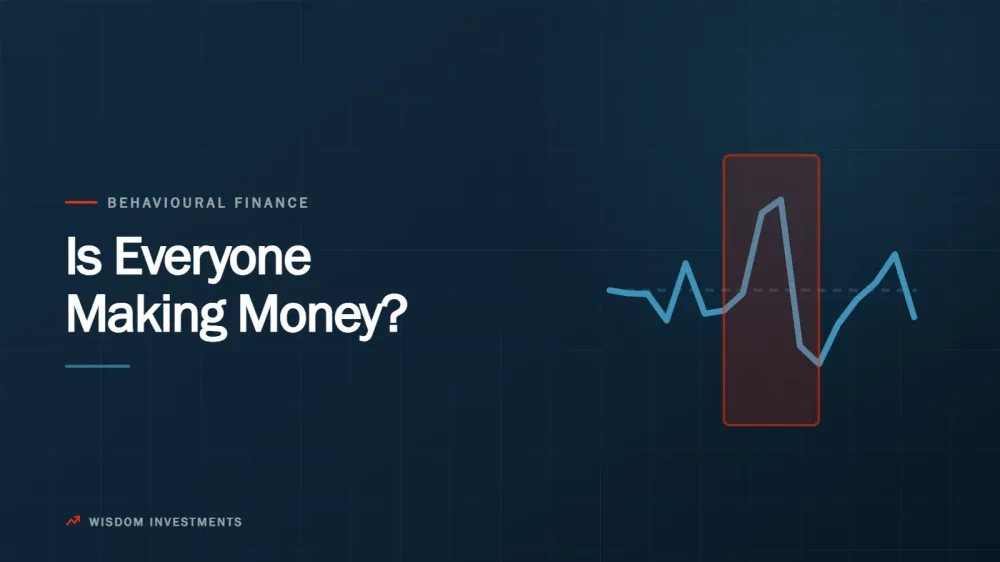
Here is the part that gets missed. The impression that everybody else is making money is not built on a fair sample. It is built on what people choose to tell you.
Think about who talks. The colleague whose punt tripled tells you at length. The same colleague's three positions that went nowhere, and the one that halved, do not come up. Nobody opens a conversation with "I have lost a third of what I put in." Not because they are lying — because it is humiliating, and there is no social reward for saying it.
So the reports reaching you are filtered twice: only the people who did well speak, and even they mention only the part that did well. You then compare your entire portfolio, losses included, against everybody else's highlights. Of course you come out badly. The comparison was never fair — and the feeling that you are the only one missing out is almost always false.
When everybody is talking about it
There is an old story that Joseph Kennedy sold his shares shortly before the 1929 crash after a shoeshine boy offered him stock tips — the reasoning being that when someone with no interest in markets is handing out tips, the enthusiasm has spread as far as it can go.
The story may well be apocryphal. The observation underneath it is still useful: when a subject moves from the business pages to the dinner table, and people swap tips the way they swap recipes, that tells you something about how many have already arrived.
You could see the same thing during 2020-21, when a very large number of Indians opened trading accounts for the first time, in the middle of a pandemic and a sharp recovery in prices. That tells you nothing about what happens next. It tells you how many people had recently decided this was interesting — which is a fact about the crowd, not about the market.
There are also valuation measures — the price of an index compared with the earnings of the companies in it, or with their book value. They tell you how much is being paid for each rupee of profit or assets, and how that compares with other times. What they do not do is tell you when anything will change.
So is a crash coming?
Nobody knows, including everybody who says otherwise with confidence.
Falls are a permanent feature of markets and one will come eventually. It might start next month or in several years. High valuations and crowded enthusiasm do not carry a date on them, and markets have run further and longer than seemed reasonable many times, in both directions. Anyone who claims to have identified the top is guessing in a confident tone — including the ones who turn out to be right.
Living with the feeling
You are not going to stop feeling this. It is old wiring and it does not switch off. What you can do is stop letting it operate the controls.
Separate the itch from the plan
Some people handle it by ring-fencing. The bulk of the money stays on whatever approach they settled on when they were calm, and is treated as off-limits. Anything speculative they want to try, for the interest or the thrill of it, goes in a deliberately small and entirely separate pot, on the understanding that the money in it may not come back.
The point is not the pot. It is the wall. The damage from FOMO usually happens when the excitement is allowed to reach into the serious money.
Get better at being out of the loop
Things are happening that you are not part of. That is a permanent condition, not a problem to solve. Every yes is a no to something else, and this is as true of investments as it is of Saturday nights. Anil Dash coined the term JOMO — the joy of missing out — for the opposite habit: attending to what you are actually doing instead of auditing what everybody else is doing.
Notice what the fantasy is really about
The tempting version is never "I would like to build wealth steadily." It is "one good hit clears the loan, or funds the deposit, or ends the job." That is not an investment thought. It is a wish for an exit, and it is what makes the loud, fast-moving thing so hard to look away from.
Temperament matters more than cleverness here, and almost nobody works on it, because the progress is invisible. Much of self-discipline is watching other people celebrate and deciding not to join in — unrewarding in the short run, and the whole skill in the long run.
The last word
FOMO is not only a money problem. It shows up in careers, in relationships, in how people spend. The good news is that it responds to being named: once you can say "this is a feeling, not a conclusion," it loses much of its authority.
You will miss things, and some of them will genuinely have been good. Missing them is the price of having chosen something — and a much smaller price than the one people pay for chasing whatever they missed last time.
This article is general information for education only. It is not investment advice and does not take account of your circumstances. Investments in securities are subject to market risks; please read all related documents carefully before investing.