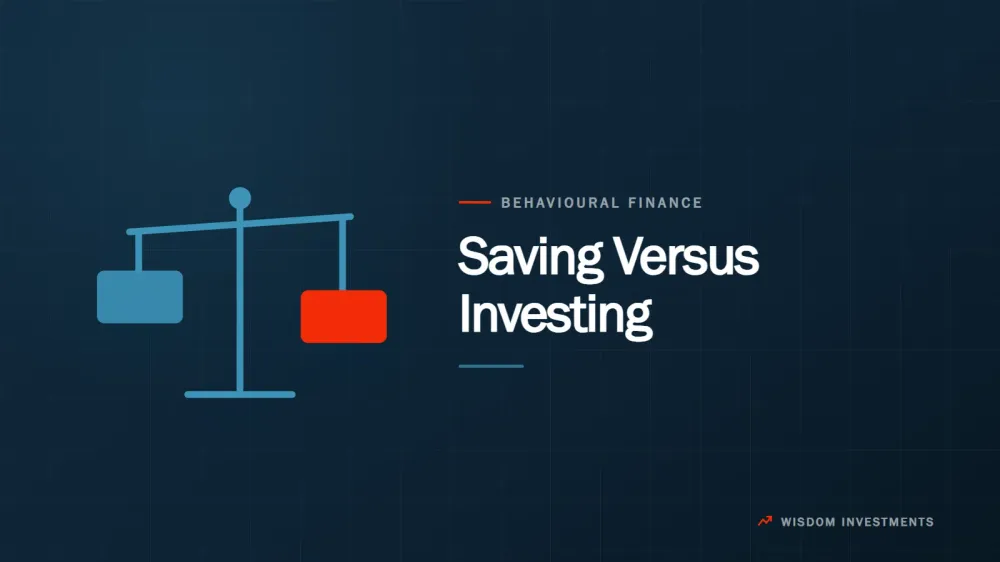
Two colleagues, same salary, same discipline. Every month Tarun moves ₹20,000 out of his salary account and into a fixed deposit. Every month Arun moves the same ₹20,000 into a fund. Ten years later they compare notes and are surprised to find they were never doing the same thing at all.
Most of us use "saving" and "investing" as though they were the same activity with different labels. They are not. They answer different questions, they carry different risks, and confusing them is one of the quieter ways people end up short of money at exactly the wrong moment.
What saving is for
Saving is setting money aside and keeping it intact. You spend less than you earn and you park the difference somewhere it will still be there, in full, whenever you reach for it — a savings account, a fixed deposit, cash.
The job of that money is availability, not growth. It is there for the hospital bill, the month between two jobs, the car repair, the wedding you agreed to attend before you saw the ticket prices. For that job, the only feature that matters is that the amount does not shrink and that you can get at it quickly. A slightly higher rate is irrelevant if the money is locked up or has fallen 15% on the week you need it.
Saved money has one weakness, and it is worth being clear-eyed about it: over long periods, prices tend to rise faster than a safe deposit pays. Your rupees stay intact while what those rupees buy quietly shrinks.
What investing is for
Investing is putting money into something whose value can go up and down — shares, funds that hold shares, property, and so on — in exchange for the possibility that it grows faster than prices do over a long stretch of time.
The word "possibility" is doing real work in that sentence. There is no floor. The value can be lower next year than it is today, and lower again the year after. That is not a malfunction of investing, it is the price of admission. What you are buying is not certainty; it is a longer horizon in which growth has a chance to outrun inflation.
Which means investment money must be money you genuinely do not need soon. If you may have to sell in eighteen months, the fall does not stay on paper — you turn it into a real loss at whatever price the market happens to be quoting that week.
Why it matters: what inflation does over ten years
Here is an illustration, and I want to be plain that it is an illustration rather than a forecast. Suppose your household spends ₹50,000 a month today, and suppose — purely as an assumption so the arithmetic has something to work with — that the cost of that same basket of goods and services rises about 7% a year. Nobody can tell you what inflation will actually be, and the real figure will wander around.
On that assumption, the identical lifestyle costs a little under ₹1 lakh a month in ten years. Not a better lifestyle. The same one.
That is the whole argument for investing, and it has nothing to do with beating the market or being clever. It is that money which must last decades has to grow against a rising cost of living, and money kept entirely safe generally does not.
You need both, for different reasons
This is not a contest, and the answer is not to pick a side.
- Cash and deposits handle the near term — emergencies, and anything you will spend within the next few years. Certainty is the feature you are paying for.
- Long-horizon assets handle the far term — the money you will not touch for a decade or more. Volatility is the price you are paying.
The mistake in one direction is keeping a lifetime's savings in a deposit and wondering, twenty years on, why it does not stretch. The mistake in the other is putting next year's school fees into something that can fall 30% and then being forced to sell it at the bottom.
So the practical question is not "should I save or invest". It is: when will I need this particular money? Answer that honestly for each pot, and where it belongs mostly answers itself.
This article is general information for education only. It is not investment advice and does not take account of your circumstances. Investments in securities are subject to market risks; please read all related documents carefully before investing.