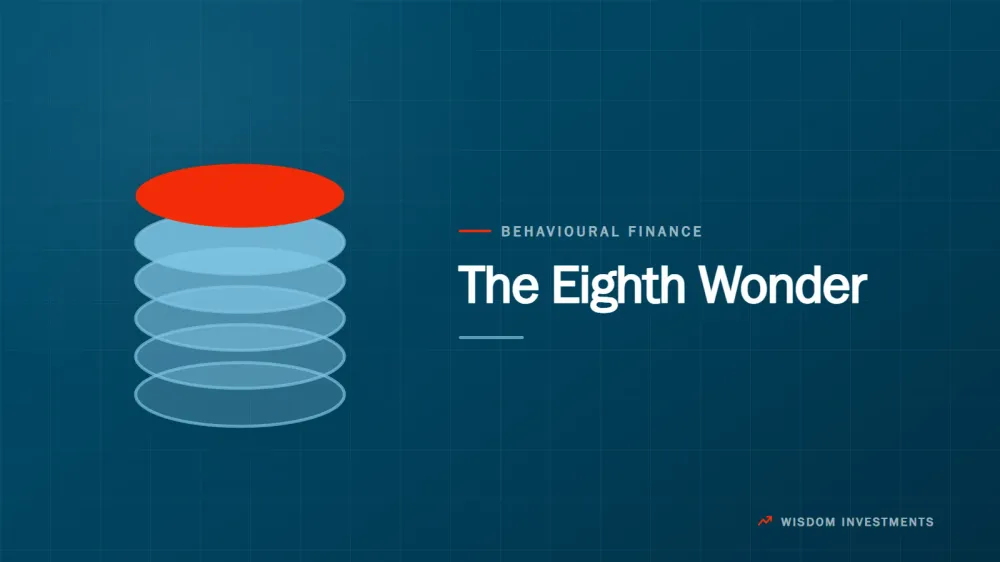
You have almost certainly seen the line: compound interest is the eighth wonder of the world; he who understands it earns it, and he who does not, pays it. It gets passed around endlessly, usually with Einstein's name attached, and there is no reliable record that he ever said it.
What is interesting about the saying is not the first half, which everyone quotes. It is the second half, which almost nobody finishes.
The part of the curve that does the heavy lifting
Compound growth is badly misunderstood as "steady growth". It is not steady at all in terms of what it adds. The amount added in each period depends on how big the pile already is, so the additions get larger as you go.
Here is the cleanest way to see it, with no rates and no forecasts involved. Imagine any amount that doubles, repeatedly. It goes 1, 2, 4, 8, 16. Look at the last step. Going from 8 to 16 adds 8 — which is more than every earlier step put together added.
That is the shape of the thing. The final stretch contributes more than the whole beginning did. Not because anything changed, but because the base was biggest at the end.
Two practical consequences follow from that shape, and they are the useful part.
The early years are the least impressive and the most important. They produce the smallest visible gains, which is why people abandon them. But they are what makes the base large enough for the later years to matter. You cannot have the last doubling without the first one.
Cutting a long horizon short near the end is unusually costly. Pulling money out three years before a fifteen-year goal is not losing three years out of fifteen. It is losing the three years that would have added the most. The cost is not proportional to the time.
The half nobody finishes: he who does not, pays it
The same arithmetic runs in the other direction, and it does not care which side of it you are on.
A credit card balance you carry forward, or a personal loan you keep rolling, compounds against you on exactly the same mechanism. The interest is added to what you owe, and the next round of interest is charged on that larger amount. The pile grows fastest when it is already large, which is why a debt that felt manageable can become very hard to catch up with while you are making payments the whole time.
This is what the saying means by paying it. Not that you missed out on gains — that you are on the wrong end of the same curve, and it is working on someone else's behalf at your expense.
Why the framing is worth keeping
Calling it a wonder of the world is a bit of theatre, and there is nothing mystical here. It is ordinary arithmetic applied over an unusual length of time, and human beings are famously bad at picturing what ordinary arithmetic does over an unusual length of time. Our intuition draws straight lines. The maths draws a curve.
So the practical takeaway is not "compounding is powerful, go and invest". It is narrower and more useful than that: whenever you are looking at something that compounds — a long-term investment, a home loan, a revolving balance — your gut estimate of where it ends up will be wrong, and it will be wrong in the same direction every time. It will be too low. Check the arithmetic rather than trusting the feeling.
This article is general information for education only. It is not investment advice and does not take account of your circumstances. Investments in securities are subject to market risks; please read all related documents carefully before investing.