"The market looks expensive right now. I will start once it corrects." A few months later the correction arrives, and the same person says, "Let me wait until things settle down." Then things settle down, prices have moved up, and it is expensive again.
Nobody in that conversation is being lazy or stupid. They are doing something that feels responsible: waiting for a better moment. This post is about why that particular kind of waiting so rarely ends.
The trigger keeps moving
When someone says they are waiting, they almost never state the condition precisely. Ask what exactly has to happen before they start, and you usually get something like "when it calms down" or "after the results are out" or "once there is more clarity".
None of those are conditions you can check. There is no day on which the market publishes a notice saying the uncertainty is over. So the person waits, and because the condition was never testable, it quietly gets replaced by a new one.
When this was written in 2019, the reasons for waiting were an approaching election and valuations that looked stretched. Both were real. Both were replaced within a year by an entirely different set, which were replaced again after that. There has not been a year without a convincing reason to wait, and there is not going to be one.
There is an observation made often enough by long-serving fund managers that it is worth stating plainly: far more money has been lost by people preparing for a fall, or trying to get ahead of one, than was ever lost in the falls themselves. The waiting is not the safe option it feels like. It has a cost, and the cost is simply invisible, because nobody sends you a statement for the years you spent out.
Why the timing has to be right twice
People underrate how hard this is because they only count half the problem.
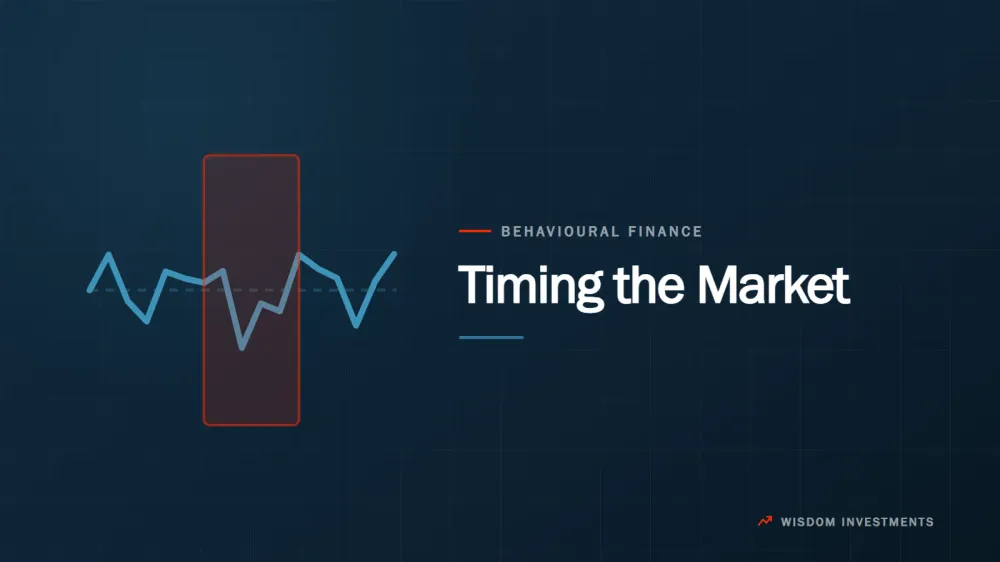
Staying out is one decision. Getting back in is a second, entirely separate one, and it has to be made at the moment when everything you can see and read is telling you not to. The bottom of a fall does not feel like an opportunity while you are standing in it. It feels like the beginning of something worse — which is precisely what makes it the bottom.
So avoiding a fall does not finish the job. You then have to act against your own instincts, on a day nobody will identify for you. Avoiding the fall and missing the recovery is a common outcome, and it is worse than having sat through both.
Returns are not spread evenly
Growth over a long period does not arrive smoothly, a little each week. A disproportionate share of it turns up in a small handful of days — and those days are not scattered at random. They cluster around the worst periods, often within days or weeks of the sharpest falls, because that is when sentiment turns hardest.
This is a description of shape, not a claim about what any index does next. But it has an awkward consequence: someone who steps aside to avoid the bad days is standing in exactly the wrong place to catch the good ones, since the two sit side by side. You do not find out which kind of day it was until afterwards.
What the alternative actually is
The alternative to timing is not cleverness. It is a decision made once, in advance, about how much goes in and how often — and then not revisited every time the news changes. A rule you set when you are calm is the only thing that will still be working when you are not.
None of this says anything about whether now is a good time or a bad one. Nobody knows that, including the people who say it with confidence. It says something narrower: that "I will start when things look clearer" is not a plan, because things never look clearer. The people who eventually start are the ones who stopped requiring them to.
This article is general information for education only. It is not investment advice and does not take account of your circumstances. Investments in securities are subject to market risks; please read all related documents carefully before investing.