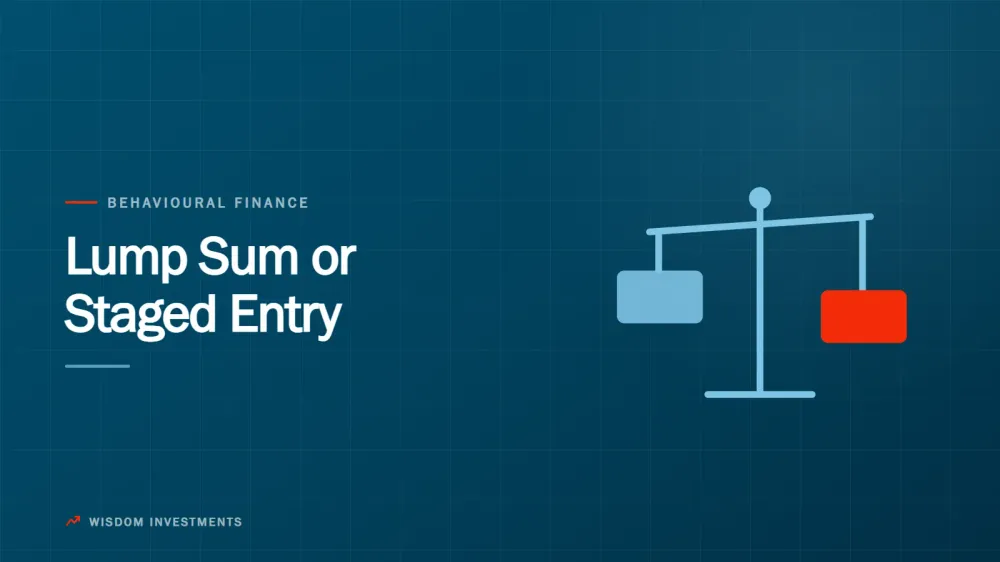
Anisha has just inherited a little over ₹50 lakh from her grandmother. She knows the money should not sit in a savings account for the next twenty years. What she does not know is how it should go in. All of it, this week? Or into a low-risk fund first, moved across into equity in twelve monthly slices, so that a bad month right after she invests does not swallow the whole amount?
This is one of the most common questions an ordinary investor ever faces, and it comes with a real fear attached. Nobody wants to put in a lifetime's windfall on a Tuesday and watch the market fall on Wednesday.
Two words first, because the rest of this depends on them. Rupee-cost averaging means putting money in across several dates instead of one, so the price you end up paying is an average of several prices rather than a single one. A Systematic Transfer Plan (STP) is the mechanical version of that for mutual funds: the money is parked in a low-volatility fund and a fixed amount is moved into an equity fund every month until the parked pile is empty.
This article sets out the case for putting the money to work in one go. There is a serious case on the other side too, and a companion article on this site sets that one out. Read both before you decide anything.
The reason you are buying equity is the reason not to sit in cash
Anyone who buys equity is doing it for one reason: they expect it, over long stretches, to earn more than cash. That belief is the whole basis of the decision. But money waiting in a parking fund is not doing that job. It is sitting out.
So staging the entry has a cost that is easy to miss because nothing bad appears to happen while you are paying it. If half the money spends the year in a low-risk fund, half the money spent the year not being invested in the thing you decided was worth investing in. That is the trade being made, and it is worth naming plainly rather than treating the staged route as free protection.
A large amount of cash quietly rewrites your allocation
There is a second cost, and it is more subtle. Suppose someone has settled on a mix of 70% shares and 30% bonds because that is the level of movement they can live with. Now a windfall lands that is roughly the size of the existing portfolio, and it goes into a parking fund for a year.
Look at what the whole pot now is. The old holdings are still 70:30, but they are now only half the total. So the combined position is about 35% shares, 15% bonds and 50% cash. That is not the mix anyone chose. It is a far more conservative portfolio than the one the person decided was right for them, and it stays that way until the transfers finish.
If the plan is then interrupted — the transfers get paused during a scary month, or the whole thing is simply forgotten about — the cash does not sit there for a year. It sits there indefinitely, and the portfolio permanently is not the portfolio that was designed.
Staging is a view about prices, even when it doesn't feel like one
Here is the part that most people staging their entry have not consciously worked out. An STP only leaves you ahead of a single upfront purchase if the average price over the transfer period turns out to be lower than today's price. That is not a neutral, cautious position. It is a specific expectation about what prices will do over the next several months.
Putting the money in at once makes no claim about the near future at all. It says only that you do not know, and that you are not going to pretend otherwise. Whatever else can be said about the two routes, the single purchase is the one that requires fewer predictions.
And note the awkward shape of the staged route: the scenario in which it does the most good is a market that keeps falling for months. That is exactly the scenario in which almost nobody keeps calmly transferring money in on schedule. The strategy's best case and the investor's weakest moment are the same event.
The switching itself is not free
An STP is not one transaction, it is a series of them. Every transfer out of the parking fund is treated as a redemption of that fund, which means any gain sitting in it can become taxable at that moment, repeatedly, through the whole transfer period.
The specific rates and holding periods that applied when this was originally written have since changed, and there is no point in restating them here — check the current position for your own situation before assuming anything about the tax treatment. The structural point survives the rule changes: a staged entry creates a string of taxable events that a single purchase does not.
Where this genuinely does not settle it
None of the above proves anything about how the next twelve months will go, and it is not meant to. Even if someone told you exactly where the market would be a year from now, that still would not tell you which route worked out, because the answer depends on the path: fall then rise, and the staged entry picked up the cheaper prices; rise then fall, and the single purchase locked in the lower starting price. Nobody has the path.
There is also a limit on how much any argument about arithmetic is worth. The route that leaves someone unable to sleep, or that ends with them selling everything after a bad quarter, is not the sensible route for that person no matter how the sums look. Sequence of returns and your own reaction to a fall are the substance of the case on the other side, and they deserve a fair hearing.
What it comes down to is your horizon and your honest answer to one question: if the money went in on Monday and the market dropped sharply on Friday, what would you actually do? Someone who would leave it alone for fifteen years and someone who would call their bank in a panic are not facing the same decision, even though the money looks identical.
One last thing worth saying. If putting the full amount in feels unbearable, that discomfort may not be about the timing at all. It may be telling you that the portfolio you were heading into carries more movement than you can tolerate. Adjusting what the money is going into is a different lever from adjusting when it goes in, and it is often the one actually being asked about.
This article is general information for education only. It is not investment advice and does not take account of your circumstances. Investments in securities are subject to market risks; please read all related documents carefully before investing.